
New: LearningStone content editing with live view
Building a LearningStone course timeline just became a lot easier. With the new live view, you edit a module and see the result right next to it. You don’t have to click back and forth between…
Leaders don't learn from a PowerPoint. They learn from real situations, difficult conversations and honest feedback. Leadership development stands or falls with transfer: what does a participant take back to the workplace? Classic training events with lots of lecturing and little doing have little effect on lasting behavioural change. These 6 training activities combine online preparation with live interaction - using LearningStone to keep the connection alive before, during and after training.
This is an article in the "Blended training activities with LearningStone" series of the LearningStone blog - for trainers who want to get more out of their learning environment. Copyright: LearningStone.

Active learning is not a trend - it is science. In 2025, Harvard Business Publishing surveyed more than 1,100 L&D professionals and leaders across 14 countries for their Global Leadership Development Study. One of the central findings: organisations are shifting from one-off training events to continuous, blended learning programmes that combine online preparation with live interaction and practical assignments. Experiential learning - doing, reflecting and applying - is rated as most effective for lasting behavioural change.
That blended learning works is also confirmed by academic research. A systematic review published in Heliyon (2024) examined dozens of blended learning designs and concluded that well-designed blended learning strategies - with active work forms, peer feedback and rapid feedback loops - significantly improve learning outcomes compared to purely classroom-based instruction. The combination of online preparation and live sessions leads to greater cognitive processing, higher engagement and better transfer to practice.
Sources:
- Harvard Business Publishing (2025). 2025 Global Leadership Development Study: Research Findings. harvardbusiness.org
- International Journal of Multidisciplinary Approach Sciences and Technologies (2024). Blended Learning Environments: A Systematic Review of Effective Strategies in Educational Settings. Vol. 1(2), 120-132.
- Hattie, J. (2023). Visible Learning MetaX. Routledge.
Online (in advance): Participants watch a video lecture or read a case study via the course timeline in LearningStone. Add the video directly as a content block - you can use YouTube, Vimeo or a self-uploaded file. This way participants have everything in one place and you can see who has already viewed the content via the progress report.
Live (during): Participants break into small groups to analyse the case and present their approach. The trainer facilitates the discussion and deepens the theory. Because participants arrive well prepared, there is more room during the session for genuine depth.
Goal: active processing of theory and mutual knowledge exchange. The in-person session is used for discussion rather than lecturing.
Online (in advance): Each participant shares a current case from their own practice via LearningStone. This can be done as a post on the discussion board or as a document in a shared Docs folder. Fellow participants read each other's contributions and prepare feedback. You can schedule an automatic discussion board message in the course timeline as an invitation to post - so no one forgets.
Live (during): During a peer consultation session - online or in person - the cases are discussed using a fixed method, such as the incident method. Participants ask each other coaching questions.
Goal: practice-based learning, reflection and network building. Leaders learn most from each other - this activity gives that a solid structure.
Online (throughout the programme): Participants receive a short video or article each week via an automatically scheduled content block in the course timeline. Use LearningStone's relative scheduling to automatically release this content at the right moment - regardless of when someone enrolled.
In practice (between sessions): Participants immediately apply the theory in their team and record their experiences in a digital logbook - a form in LearningStone that they can keep adding to and saving. This builds up a rich collection of practical reflections that gives the trainer insight into the learning process.
Live (evaluation): During the session, experiences from practice are discussed: what worked and what did not? The completed logbooks serve as input.
Goal: embedding behavioural change in practice.
Online (in advance): Participants listen to a specially recorded podcast or video - a senior leader sharing a major mistake or an important learning moment. Upload the audio file or video in LearningStone as a content block, or embed an external podcast link. Add a progress marker as a listening assignment: 'What is your biggest insight from this recording?'
Live (during): Participants analyse the lessons from the podcast or video and link them to their own values. This is followed by a role play in which they have to manage a similar difficult situation.
Goal: drawing inspiration from realistic practical examples and exploring the human side of leadership. The podcast makes the preparation less static than reading a text.
Online (in advance): Participants record a short video with their smartphone - a difficult conversation or a two-minute motivational speech - and upload it to their personal folder in Docs in LearningStone. The personal folder is only visible to the participant and the coach, providing safety for this vulnerable learning moment.
Live (during): In pairs or small groups, participants watch the video recordings and give each other feedback based on pre-established criteria. The best clips are discussed in plenary. Make the feedback criteria available as a text block in the course timeline so everyone has them at hand.
Goal: increasing self-awareness and objectively observing one's own behaviour. Ideal for sharpening communication skills and non-verbal signals.
Want to know how to set up the course timeline, forms, Docs or the discussion board in LearningStone? Visit the help pages at learningstone.com.
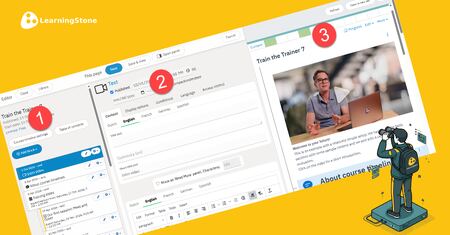
Building a LearningStone course timeline just became a lot easier. With the new live view, you edit a module and see the result right next to it. You don’t have to click back and forth between…
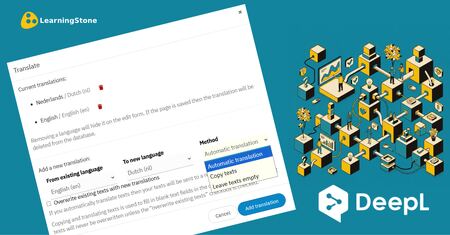
Do you train international groups? Then you know how much time it takes to translate all your content. Starting now, LearningStone will do that for you thanks to an integration with DeepL, the…

Trainers who want to make a real impact don't stop when the training day is over. Didactic coaching is a targeted approach in which the trainer stimulates participants' thinking with feedback that…